In many parts of India, factory floor temperatures during summer routinely exceed 45°C. Conventional air conditioning is simply not viable for large industrial spaces — the cost is prohibitive and the infrastructure impractical. Evaporative cooling offers a proven, energy-efficient alternative capable of dropping temperatures by 10–15°C using only water and airflow.
What Is Evaporative Cooling?
Evaporative cooling works on a simple thermodynamic principle: when water evaporates, it absorbs latent heat from the surrounding air, lowering its temperature. Unlike refrigerant-based systems, there are no compressors, no chemical refrigerants and no significant energy overhead beyond a pump and fan motor.
In an industrial air washer or evaporative cooling unit, warm outdoor air is drawn through water-saturated cellulose fill pads. As the air passes through, water evaporates into it — the air cools and picks up moisture, emerging 10–15°C lower in temperature and significantly more comfortable for workers.
Why It Works So Well for Indian Industry
Evaporative cooling is most effective in hot, dry conditions — exactly the climate across much of India during the peak summer months. Even in humid coastal regions, the large air volumes moved by industrial evaporative coolers provide significant relief through enhanced air movement and partial cooling.
- Low operating cost: Energy consumption is 70–80% lower than equivalent refrigerant-based systems, since only a pump and fan motor are required.
- Fresh air ventilation: Unlike split ACs that recirculate air, evaporative coolers continuously supply fresh outdoor air — critical in manufacturing environments with airborne contaminants.
- No refrigerants: Zero chemical refrigerants mean no F-gas compliance burden, no refrigerant leaks and no environmental liability.
- Scalable capacity: Units range from 5,000 m³/hr to 3,00,000 m³/hr — a single system or bank of units can cool an entire production hall.
- Simple maintenance: Cellulose fill pads, water distribution nozzles and fan bearings are the only wear items — and all are easily serviceable in-house.
Single Skin vs Double Skin Cabinet Units
Roots Enviro manufactures both single skin and double skin cabinet configurations. The choice depends on the application:
Single skin units are ideal for most factory floor applications — straightforward installation, lower capital cost and effective cooling for general manufacturing environments including textile mills, garment factories and auto assembly shops.
Double skin units provide superior thermal insulation and acoustic performance — better suited for environments where the unit is located close to administrative areas, or where heat gain through the cabinet itself is a concern. They also perform more consistently in extreme ambient temperature conditions.
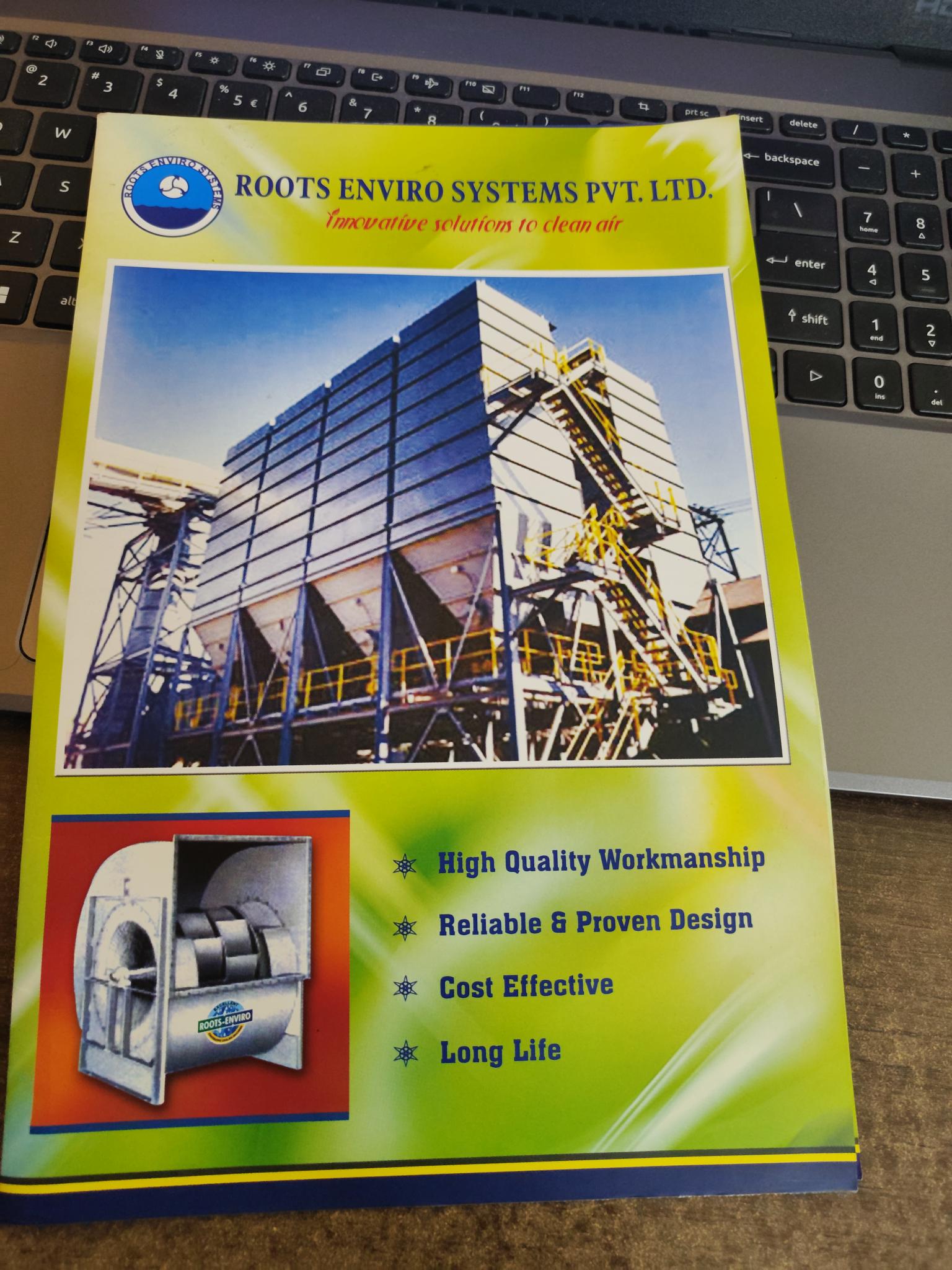
Roots Enviro evaporative air washer unit — available in capacities from 5,000 to 3,00,000 m³/hr
Typical Temperature Drop: What to Expect
The achievable temperature drop depends on two variables: the ambient dry-bulb temperature and the wet-bulb temperature (a measure of ambient humidity). The formula is straightforward:
Effective temperature drop = (Dry-bulb – Wet-bulb) × Saturation Efficiency
In a typical Indian summer scenario — dry-bulb 44°C, wet-bulb 28°C, with 90% saturation efficiency — the calculation gives a 14.4°C drop, delivering supply air at approximately 29.6°C. Even in a more humid coastal environment with wet-bulb at 32°C, you still achieve a comfortable 10.8°C reduction.
Industries Using Evaporative Cooling
Evaporative air cooling systems from Roots Enviro are deployed across a wide range of demanding industrial environments:
- Textile and garment manufacturing — spinning, weaving and stitching halls
- Automobile assembly plants — painting, pressing and assembly lines
- Food processing and cold chain facilities
- Poultry and livestock farming — maintaining optimal rearing temperatures
- Large warehouses and logistics hubs
- Power plant turbine buildings and substations
Conclusion
For large industrial spaces in India’s climate, evaporative cooling is not just a cost-effective option — it is frequently the only practical option. The combination of low capital cost, minimal operating expense, fresh air delivery and zero refrigerant footprint makes it a compelling choice for any facility manager serious about worker comfort and productivity.
If you are evaluating evaporative cooling for your facility, Roots Enviro’s engineering team can assist with heat load calculations, unit sizing and system layout. Contact us for a free technical consultation.

.jpg)